Powered By


Powered By
Powered By
A site goes live. Pages are filled with clear words. Important terms appear where they should. Yet when you search your company name, someone else shows up first with ratings, FAQs, pricing and business details visible right in Google.
That difference often comes down to one thing: schema markup.
While many businesses chase trends, schema works quietly in the background, helping search engines understand your content better and display it more effectively.

Schema markup is structured data added to your website using JSON-LD. It doesn’t change how your site looks, but it changes how search engines read it.
Think of your website like a product on a shelf. Without schema, search engines must figure everything out manually. With schema, you give them a clear label-price, type, purpose and details-all instantly readable.
This helps Google present your content with enhanced results like ratings, FAQs, pricing and more.
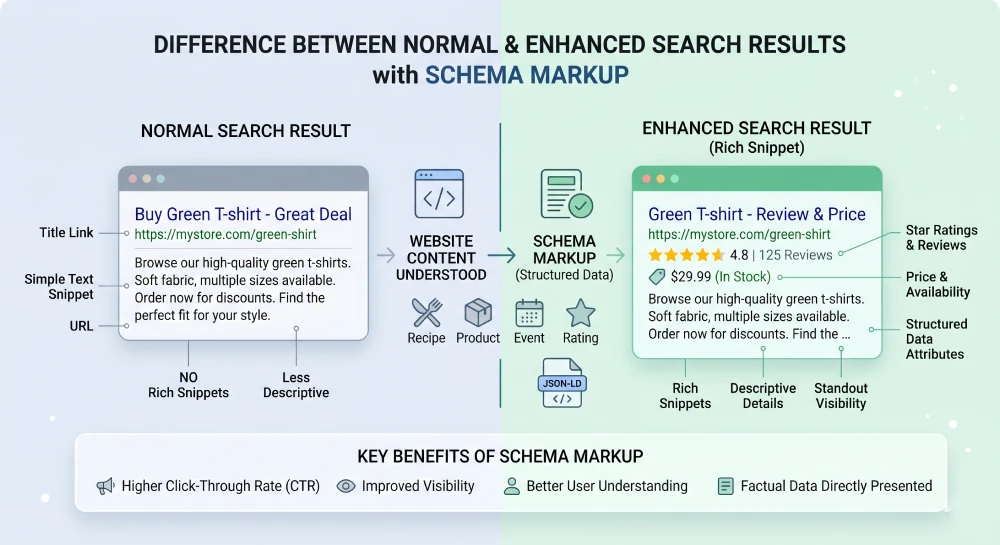
Search engines no longer rely only on keywords. They focus on meaning and intent. Schema helps them understand your content with precision.
With FAQ schema, your questions and answers can appear directly in search results. This increases visibility and builds trust before users even click.
Review schema allows star ratings to show beside your listing. These visual cues can significantly improve click-through rates.
Schema helps display your location, contact details and business hours clearly. This improves your chances of appearing in local search and maps.
Breadcrumb schema shows your page structure in search results. This improves clarity and user trust.
If you run promotions or events, schema allows those details to appear directly in search results, helping you stand out.

In 2026, many users get answers directly from AI tools instead of visiting websites. Platforms like Google AI Overviews and voice assistants rely on structured data.
Schema helps your content become a source for these answers by organizing information clearly for machines.
For example, if someone searches for local web design services with pricing, structured data increases your chances of being selected as a source.
GEO focuses on getting your content mentioned in AI-generated responses.
Key schema types that support this include:
These help AI systems understand and trust your business data.
Schema is usually added using JSON-LD inside your website’s HTML.
{
"@context": "https://schema.org",
"@type": "LocalBusiness",
"name": "ItsProWebsite",
"url": "https://www.itsprowebsite.com",
"telephone": "+1-431-337-6909",
"address": {
"@type": "PostalAddress",
"addressCountry": "CA"
},
"openingHours": "Mo-Fr 09:00-18:00"
}
If you're not technical, platforms like ItsProWebsite handle schema automatically during development.
You can also validate your schema using Google’s Rich Results Test.

Websites built by ItsProWebsite include structured data from the start, including LocalBusiness, FAQPage, Service and Article schema.
For deeper understanding of how your website structure impacts performance, read this guide: What is a CMS and which one is right for your business in 2026.
Schema works even better when combined with a strong CMS that supports structured data properly.
Search has changed. AI tools answer questions before users click. Voice search continues to grow.
Businesses that provide structured, machine-readable data stay visible. Others get ignored.
If you're unsure whether your website uses schema correctly, you can request a review.
Get in touch today and ensure your business appears where it matters most-search results, AI answers and voice queries.
Schema markup is a type of structured data added to your website that helps search engines understand your content better. It allows Google to display enhanced results like star ratings, FAQs, pricing, and business details directly in search listings.
Schema markup does not directly increase rankings, but it improves visibility through rich results. These enhanced listings attract more clicks, which can indirectly boost your SEO performance.
In 2026, search engines and AI tools rely heavily on structured data to generate answers. Schema markup helps your content get picked for AI overviews, voice search responses, and featured snippets.
Small businesses should use LocalBusiness, FAQPage, Service, Article, Review, and Breadcrumb schema. These help improve local visibility, trust, and overall search performance.
981 Main St West, Hamilton, ON L8S 1A8, Canada.

Priyank Patel is the Founder & CEO of HRINFOCARE Limited. With over 20 years of experience in web development, software solutions, AI integration, SEO, and business automation, he has helped companies across Canada, the United States, and internationally build scalable digital solutions.
Unlike traditional agencies where consultations are handled by sales representatives, your strategy session is conducted directly by Priyank, providing practical business and technical guidance based on real-world experience.

