Powered By

Powered By
Powered By
Most small biz folks think cyber crooks ignore them - just go after big companies. Truth is, by 2025, it’s totally flipped.
Facts show that small businesses face cyberattacks every 11 seconds. Nearly half of all data breaches target organizations with fewer than 1,000 employees. The reason is simple. Smaller companies often lack the tools, monitoring, and security staff needed to defend against modern threats, making them easy targets for attackers.
The average cost of a single cyberattack on a small business is around $120,000. Even worse, nearly 60 percent of affected companies shut down within six months of an incident.
Your website stores customer data and generates revenue. Protecting it is not optional. Ignoring security puts the entire business at risk. Below is the five-step security framework we follow at ITSPROWEBSITE to keep client websites protected.
Strong website security relies on multiple layers working together to defend against common threats such as phishing, ransomware, and malware.
Security starts with encryption. An SSL certificate encrypts the connection between a visitor’s browser and your server. Without SSL, sensitive information such as passwords and payment details can be intercepted during transmission.
You can confirm SSL is active by checking for the lock icon in the browser address bar. Sites without HTTPS are marked as “Not Secure,” which damages user trust and hurts search engine rankings.
Modern standard: SSL should be free and automatically renewed. All ITSPROWEBSITE plans include managed SSL and HTTPS at no extra cost.
Backups do not prevent attacks, but they are critical when something goes wrong. Most website incidents result from human error or ransomware. A clean backup allows fast recovery.
Ask yourself whether your site is backed up automatically and whether those backups are stored off-site. If backups live on the same server, attackers can compromise them too.
Why it matters: Fast restoration minimizes downtime and financial loss. We maintain automatic backups stored separately from the live environment.
If your site uses a CMS like WordPress, regular updates are essential. Each update patches known vulnerabilities. Skipping updates is similar to leaving your front door unlocked.
Many business owners do not have time to manually update plugins, themes, and core software every week. Unpatched systems are one of the most common attack vectors.
The fix: Ongoing maintenance ensures your CMS remains secure and reduces exposure to known threats.
A significant number of small business breaches happen due to compromised login credentials. Weak or reused passwords create an easy entry point for attackers.
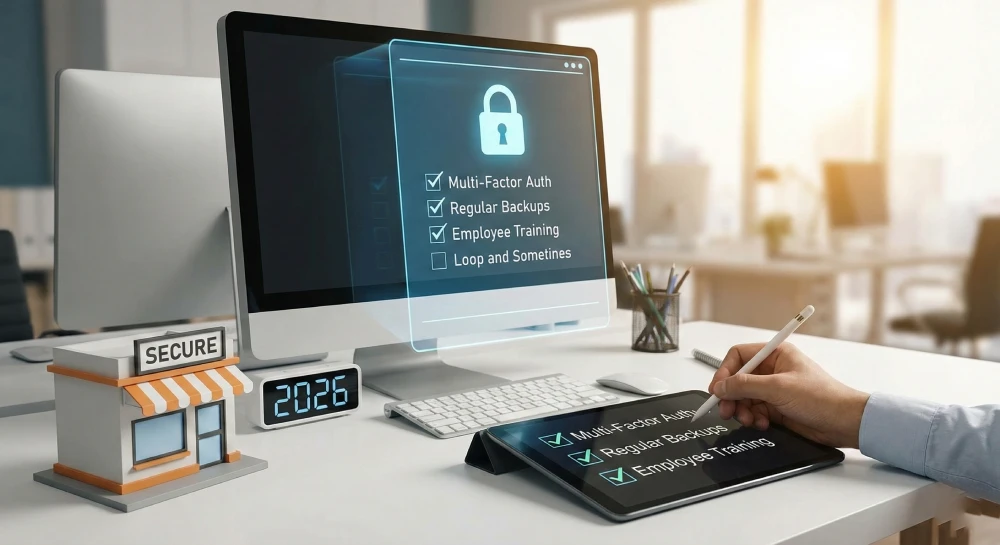
Admin accounts should never rely on simple or reused passwords. Multi-factor authentication adds a critical extra layer of protection.
Best practice: Enable two-factor authentication on all admin and email accounts, use unique passwords for every service, and store them securely in a password manager.
Server-level protection blocks malicious traffic before it reaches your website. A Web Application Firewall (WAF) prevents attacks such as SQL injection and malicious scripts.
DDoS protection stops traffic floods designed to overwhelm your server and take your site offline. Basic hosting plans often lack these protections.
A properly configured WAF filters out bots and automated attack attempts, keeping your website safe by stopping threats early.
The damage from a security breach extends far beyond immediate financial loss. Downtime affects sales, operations, and customer trust long after the incident.
Security is not a one-time task. It requires consistent monitoring, updates, and protection.
Managing SSL certificates, off-site backups, software updates, and server security can be overwhelming. That is why ITSPROWEBSITE offers security as a service.
Our affordable monthly plans cover all five security pillars, including hosting, automated backups, ongoing updates, and professional support. This allows you to focus on running your business while we protect your website.
Do not leave your business exposed. Protect what comes next. Explore our secure website solutions today.
Small businesses are a prime target for hackers because they often lack advanced security tools. A single breach can lead to data loss, downtime, legal issues, and loss of customer trust.
The most common causes are outdated software, weak passwords, and missing security patches. Many attacks exploit known vulnerabilities that were never fixed.
Yes. SSL encrypts data between your website and visitors. Without it, login details and payment information can be intercepted. Google also ranks HTTPS sites higher.
Backups should run automatically at least once per day. For active sites, hourly backups are ideal. They should always be stored off-site for safety.
981 Main St West, Hamilton, ON L8S 1A8, Canada.

Priyank Patel is the Founder & CEO of HRINFOCARE Limited. With over 20 years of experience in web development, software solutions, AI integration, SEO, and business automation, he has helped companies across Canada, the United States, and internationally build scalable digital solutions.
Unlike traditional agencies where consultations are handled by sales representatives, your strategy session is conducted directly by Priyank, providing practical business and technical guidance based on real-world experience.

